


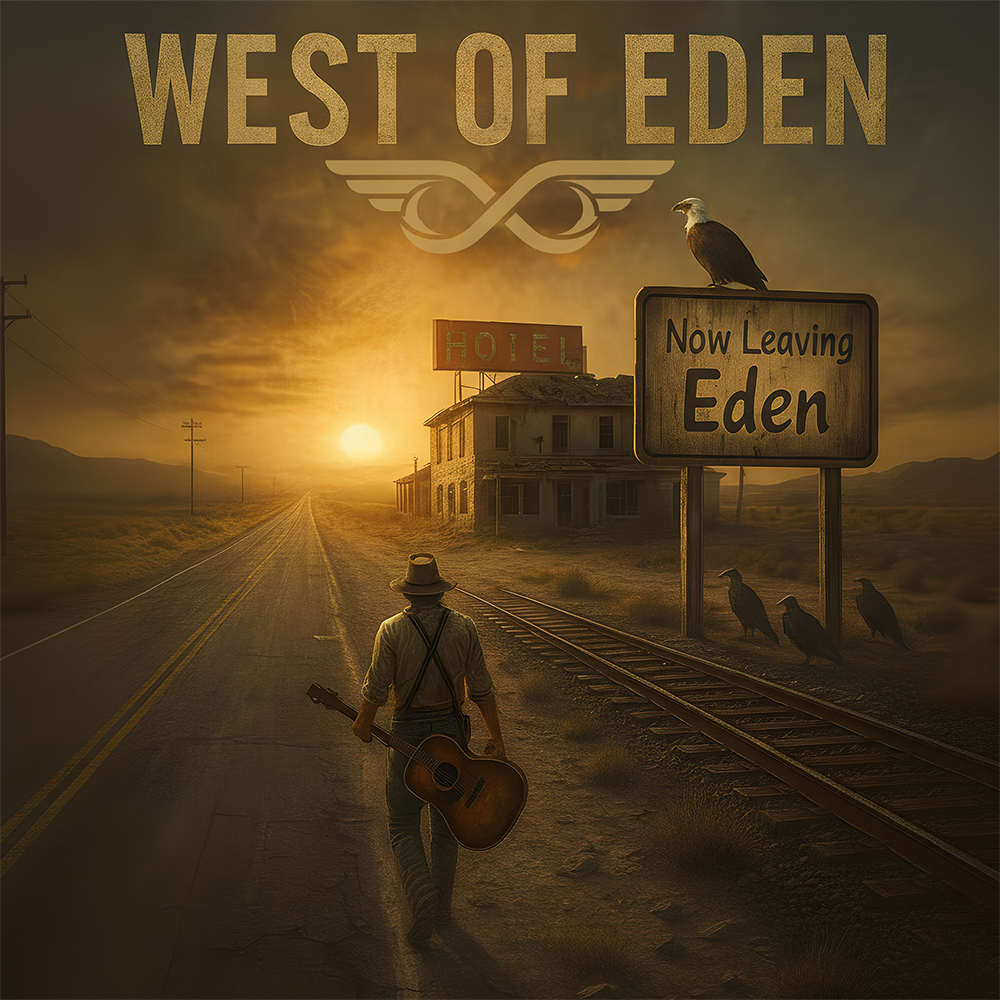
West of Eden
A concept record about leaving the place that made you and the reflections along the way.
Liner Notes
West of Eden is a record born from inspiration. Not imitation, not replication, but reflection.
Eden is often imagined as a place of peace and innocence, but it is also where life happens. It is where love forms and fractures, where desire and consequence coexist, where ambition rises alongside loss. Eden holds both serenity and struggle.
West of Eden lives in the space that follows. It explores the act of leaving what shaped us, not always to escape it, but to understand it. For some, that journey feels like moving forward into something new. For others, it resembles a long road toward reflection, a walk through memory, perspective, and acceptance.
The album does not unfold in a straight line. Instead, it presents a collage of moments, emotions, and styles. Each track stands on its own, yet speaks quietly to the others. Together, they form a journey without a fixed destination, moving westward, still in motion, still unfolding.
West of Eden is best experienced as an open road rather than a mapped route. It invites listening in sequence or out of order, returning to familiar moments and discovering new ones along the way. The meaning is not fixed. It reveals itself differently depending on where the listener stands when they arrive.
Listening Notes
This record is designed to be lived with. Headphones are recommended, but not required. Some tracks ask for attention to lyrics, others to mood, texture, or space.
There is no single correct order, and no expectation of a complete understanding on first listen. Like memory itself, West of Eden reveals more over time.
Track Notes and Lyrics
These notes offer context, not instruction. Open the tracks that call to you by clicking on the track name.
Lyrics are included for those who want to sit with the words on the page, but they aren’t required to understand the songs. Some moments are meant to be felt first, then read later — or not read at all.
If you prefer to experience the album in motion, the complete collection of official lyric videos is available on YouTube, presented in album order.
01Across The Room
Description:
Across The Room unfolds in a late-night bar where posture, instinct, and intention quietly collide. The song lives in the charged space between confidence and temptation, where the narrator watches a familiar scene play out and immediately recognizes its imbalance. He sees the hierarchy in the room, understands the nature of the attention being given, and places himself above it, at least in his own mind.
The track is steeped in seduction, not just sexual, but psychological. It captures the moment when awareness sharpens desire rather than diffusing it. What begins as judgment slowly reveals vulnerability, as the very distance the narrator uses to separate himself from the others becomes the thing that exposes him.
Perspective:
The perspective is dominant, self-aware, and quietly confrontational. The narrator positions himself as an observer with clarity, speaking from a place of perceived control. He sees himself as different from the others in the room, more discerning, more restrained, more honest about what is happening.
Yet that confidence is fragile. Beneath the surface, the same pull is at work. The perspective never confirms whether the narrator intervenes or gives in, leaving the listener suspended in that final moment where strength and weakness look almost identical.
What to Listen For:
Listen for how the groove holds tension without release. The rhythm moves steadily, never rushing forward, allowing the atmosphere to thicken rather than resolve. Guitars and keys stay smoky and restrained, reinforcing the feeling of watching rather than acting.
The harmonies add polish and confidence, amplifying the narrator’s sense of superiority, while subtle instrumental accents hint at the underlying vulnerability beneath that posture. The arrangement feels like an explosion through the chorus, but its still restrained, mirroring the unresolved choice at the heart of the song.
Connections:
Across The Room introduces one of West of Eden’s central tensions: the distance between understanding and action. It establishes the album’s interest in moments where self-awareness does not immediately translate into strength, and where judgment of others can mask personal susceptibility.
This theme echoes throughout the record in different forms, as characters repeatedly confront situations where knowing better does not necessarily mean doing better. The road west begins here, in a room where everything is visible, but nothing is decided.
Lyrics:
Neon flickers through the cigarette haze
Same old jukebox, same old plays
Another night, another crowd of fools
All talkin’ loud and breakin’ rules
Then she walks in, heads all turn
Every cheap heart starts to burn
They see her smile, her lips, her eyes
But they never see the compromise

Across the room, I see it clear
She don’t belong with the wolves in here
They ain’t lookin’ at her shoes
They just see somethin’ they can use

She’s out of place in a bar like this
Chasin’ some kind of lonely bliss
She wants to dance, but not to fall
She wants to matter most of all
Those city wolves, they circle fast
Sayin’ “baby this” and “baby that”
She laughs a little, hides her shame
Pretends she’s playin’ their little game

Across the room, I taste the proof
Of how the night can twist the truth
They ain’t lookin’ at her shoes
And I can’t stop starin’ too

Maybe I should stand, ask her name
Tell her this place don’t play fair games
But the glass is cold, the whiskey’s warm
And I’ve seen this dance become a storm

Across the room, I see it clear
She don’t belong with the wolves in here
They ain’t lookin’ at her shoes
They just see somethin’ they can use

She turns my way, our eyes collide
I feel that pull I can’t decide
I toss some cash, I rise too soon
And vanish slow across the room
02I Found The Key
Description:
I Found The Key captures the moment when freedom stops being a fantasy and becomes a decision. The song opens in motion, not escape, but forward momentum fueled by clarity. Doubt is left behind without ceremony, not because it disappeared, but because it no longer holds authority.
Rather than framing liberation as victory over someone else, the track frames it as ownership of self. The happiness here is earned, grounded, and uncomplicated. What emerges is not rebellion, but relief, the realization that peace was never locked away, only overlooked.
Perspective:
The perspective is assured and grounded, spoken from a place of arrival rather than departure. The narrator is no longer negotiating with the past or explaining himself to anyone. He speaks as someone who has already done the internal work and is now living inside the result.
There is confidence without arrogance here. The voice does not boast or retaliate. It simply states the truth as it now exists, fully aware that the key was always within reach.
What to Listen For:
Listen for the sense of lift and openness throughout the track. The rhythm moves with purpose, driven by steady drums and bright guitar work that evoke movement rather than urgency. The slide guitar adds warmth and color, reinforcing the feeling of sunlight and open space.
Harmonies are full and supportive, widening the emotional frame of the song and amplifying its sense of freedom. Nothing feels forced or rushed. The arrangement mirrors the song’s message: once the weight is gone, everything moves more easily.
Connections:
I Found The Key marks the album’s first clear step forward. Where the opening track lingers in tension and unresolved choice, this song introduces clarity and momentum. It establishes a recurring idea within West of Eden: that freedom is not found by running farther, but by recognizing what was already yours.
That realization reappears later in the record in more reflective and tempered forms, as confidence is tested, challenged, and reexamined along the road west.
Lyrics:
Packed my doubts in the back of the car
Rolled the top down, followed a star
Didn’t look back, didn’t lose no sleep
Sometimes freedom’s the only leap

I found the key, it was here with me
Hidin’ in my pocket the whole damn time
Now I’m runnin’ free where I wanna be
Smilin’ wide ’cause the world’s all mine
Yeah, I found the key — and I’m finally free

Got a little house near the edge of town
Got a dog that runs when the sun goes down
Playin’ guitar on a Friday night
Singin’ out loud and it feels so right

I found the key, it was here with me
Hidin’ in my pocket the whole damn time
Now I’m runnin’ free where I wanna be
Smilin’ wide ’cause the world’s all mine
Yeah, I found the key — and I’m finally free

Used to think love was chains and pain
Waitin’ on someone else to change
But all that weight was tied to me
Turns out peace don’t need a plea

I found the key, it was here with me
Hidin’ in my pocket the whole damn time
Now I’m runnin’ free where I wanna be
Smilin’ wide ’cause the world’s all mine
Yeah, I found the key — and I’m finally free

Yeah, I found the key — and I’m finally free
03Midnight Alchemy
Description:
Midnight Alchemy is the sound of seduction curdling into realization. The song unfolds after the warning signs have already been ignored, when desire has crossed into entrapment and escape is no longer an option. What makes the track powerful is not the attraction itself, but the moment the narrator understands the cost and feels the weight of it settle in.
The atmosphere is thick and slow, heavy with heat and consequence. Every note drags, every movement feels deliberate, as if the song itself is resisting momentum. This is not the thrill of temptation, but the aftermath of giving in, when manipulation becomes visible and anger turns inward for not walking away when the chance was still there.
Perspective:
The perspective is intimate, exposed, and resentful. The narrator speaks from inside the trap, fully aware that he saw the danger and chose it anyway. There is no confusion here, only frustration, bitterness, and acceptance tangled together.
He knows he was played. He knows he ignored the signs. And now, instead of fighting the pull, he acknowledges it with a kind of exhausted clarity. The power dynamic has shifted, and the voice carries the weight of someone who understands too late that the spell has already done its work.
What to Listen For:
Listen for the way the song moves slowly but relentlessly, like something pulling you under rather than chasing you down. The groove is thick and grounded, rooted in blues and southern soul, with a swamp-like heaviness that makes everything feel inevitable.
The vocals stretch and strain, climbing into high, aching notes that sound less like release and more like resistance. Harmonies hover and repeat with a near-chanting quality, reinforcing the sense of ritual and manipulation rather than comfort. Nothing rushes. The arrangement lets the trap close gradually, leaving no clean exit.
Midnight Alchemy is not just seductive, it is consuming. It doesn’t flirt with danger, it documents the moment danger wins. The song earns its gravity by refusing to soften the outcome, allowing the listener to sit fully inside the realization that some lessons arrive only after the damage is done.
Connections:
Midnight Alchemy represents a turning point within West of Eden. It is the moment where self-awareness fails to prevent collapse, and confidence gives way to consequence. Where earlier tracks explore restraint and freedom, this song confronts the cost of ignoring both.
That sense of reckoning carries forward through the album, resurfacing in quieter reflections and hardened resolve as the road west becomes less about movement and more about survival after the fall.
Lyrics:
They told me once to turn away
Said she’d burn you if you stayed
But when she smiled beneath that neon sign
I swore I saw the moon in her eyes

Every move, a shimmer in the dark
Every word, a match to a spark
I knew the danger, still I crossed that line
Now the fire’s crawlin’ up my spine

Midnight alchemy
She’s mixin’ smoke and sin and sympathy
Turns a warning into poetry
And I can’t break free tonight
Midnight alchemy
She’s got that wild electricity
And though I know what’s wrong with me
I keep callin’ her name

She drifts like heat through a motel hall
Silver rings and a southern drawl
Every kiss is another goodbye
Every whisper pulls the tide

Her laughter’s paint on a windowpane
Sweet perfume, a hint of pain
I see her shadow where the daylight dies
A restless spirit still on the rise

Midnight alchemy
She’s turnin’ broken hearts to melody
Got the moonlight workin’ under me
And I can’t see the end in sight
Midnight alchemy
She’s mixin’ mercy with her sorcery
Draws me closer when I try to flee
And I still can’t see the light

Maybe I’m the fool they tried to save
Maybe love’s the curse I crave
She’s got that fever that don’t fade with dawn
And by the time it’s gone — I’m gone

Midnight alchemy
She’s still the fire they said she’d be
Got the moon where her heart should be
And I can’t turn away
Yeah, I can’t turn away
Midnight alchemy
04When The Music Fades
Description:
When The Music Fades captures the moment after applause loses its meaning. The song lives in the aftermath of attention, when celebration has moved on and what remains is memory, distance, and the long stretch of road ahead. It is not a collapse, but a reckoning, the quiet realization that recognition and love are both temporary, and that understanding this does not necessarily make it easier to accept.
The track drags intentionally, mirroring the narrator’s emotional state. It moves like someone driving west at dawn, awake but heavy, replaying a life that once felt loud and full. There is clarity here, but it arrives without comfort. The revelation is real, but it does not lift the weight from his shoulders.
When The Music Fades is not about failure, it is about aftermath. It gives the album emotional gravity by acknowledging that not every realization leads to triumph. Some simply teach you how to keep going when the lights are gone and the road is quiet.
Perspective:
The perspective is reflective and worn, spoken by someone who has already lived the peak and is now learning how to exist without it. The narrator is not angry or self-pitying. He is honest, sober, and quietly grieving what has passed.
There is understanding without relief in this voice. He recognizes how quickly attention fades, how love shifts, and how identity can unravel once the noise disappears. What remains is not bitterness, but acceptance laced with loneliness.
What to Listen For:
Listen for how the song resists momentum. The tempo never quite pushes forward, creating a sense of emotional gravity that pulls everything slightly behind the beat. Acoustic and electric guitars work together to create warmth without brightness, while organ and slide guitar add color that feels distant rather than celebratory.
The vocal delivery stays grounded and restrained, letting the words carry their own weight. Nothing swells dramatically. The arrangement allows silence and space to speak just as loudly as the notes themselves, reinforcing the feeling of driving through open desert with too much time to think.
Connections:
When The Music Fades deepens West of Eden’s exploration of life after illusion. Where earlier tracks deal with temptation and consequence, this song confronts what remains once both have burned out. It introduces the idea that survival after the fall requires a different kind of strength, one rooted in memory and endurance rather than desire or confidence.
This theme continues throughout the album as characters move farther west, carrying the knowledge that understanding does not erase loss, but may be the only thing that allows forward motion to continue.
Lyrics:
The talk on the street’s just an echo now
Familiar faces forget somehow
Used to be cheers, now it’s highway signs
Chasing ghosts of better times

When the music fades and the crowd moves on
You learn what stays when the shine is gone
Every road hums a song that remains
But silence remembers your name

She found her smile in another man’s eyes
I found my truth in the low gray skies
Used to have fire, now it’s just smoke
Dreams burn out, but the ashes spoke

When the music fades and the crowd moves on
You learn what stays when the shine is gone
Every road hums a song that remains
But silence remembers your name

Restless hearts still roll out west
Looking for something that feels like rest
Another night, another parade
One last round for the life I made

When the music fades and the crowd moves on
You learn what stays when the shine is gone
Every road hums a song that remains
But silence remembers your name

When the music fades and the lights grow thin
You start to see where the dark begins
I raise my glass to the life I played
And drive toward the dawn — where tequila’s made
05Return To The City
Description:
Return To The City is not a confrontation, and it is not a victory lap. It is a quiet reckoning with origin. The song captures the experience of going back to a place that shaped you, not to reclaim it, but to understand it with distance and clarity. There is no anger here, no desire to fix what was broken, only the need to see what remains and to measure how far the road actually carried you.
The track moves with restraint, allowing memory to surface without being dramatized. Familiar streets, old signs, and unchanged scars appear not as wounds, but as markers of survival. The narrator does not arrive looking for redemption or regret. He arrives simply to witness, to stand where he once stood, and to leave again knowing exactly why he did.
The closing harmonies feel like echoes rather than declarations, as if the city itself is answering from far away. What’s left is not closure, but peace with the distance between who he was, who he became, and what never changed.
Perspective:
The perspective is mature, grounded, and resolved. The narrator speaks as someone who has already made peace with his choices. He is not seeking approval, forgiveness, or belonging. He is present, observant, and emotionally steady.
This voice carries quiet strength. It acknowledges the city’s role in shaping him without assigning blame or praise. The distance is intentional. He looks back not to relive the past, but to understand it fully before continuing on.
What to Listen For:
Listen for how the song breathes. The groove is steady and unhurried, creating a sense of motion without urgency. Clean guitars and ambient textures leave space for memory to sit comfortably, while the rhythm section holds everything in place with confidence rather than force.
The harmonies are understated and deeply intentional. They do not announce themselves; they linger, especially toward the end, like reflections bouncing off empty streets. Instrumental passages carry as much meaning as the lyrics, allowing the song to speak even when no one is talking.
Connections:
Return To The City marks a pivotal moment in West of Eden. It is the first time the journey turns backward without becoming trapped there. After temptation, consequence, and reckoning, this track introduces reflection without collapse.
The idea of returning without reentering echoes later in the album as characters confront their pasts without surrendering their future. It reinforces one of the record’s core truths: understanding where you came from does not require staying there. This track is quietly powerful, and the restraint is its strength. It doesn’t shout its connection to anything. It lets the listener feel it.
Lyrics:
Came back to where I was born
That cracked-up street, that rusted sign
Put my back against that wall again
Just to see if it still aligned
The neon sky was hummin’ low
Same hum that shook me back then
Swore I’d never look behind me
Now I’m here lookin’ back again

I found the road and I outran
The noise, the fight, the concrete heat
Learned to survive before I could drive
With broken shoes and blistered feet
Thought the world would make me softer
But the city made me stay sharp
I didn’t leave to chase some dream
I left so it wouldn’t eat my heart

This ain’t redemption, this ain’t regret
Ain’t no anger, ain’t no debt
Just a quiet return to the city
To see what’s left

Still nothin’ grows between the cracks
Some new glass where the old bars stood
The streets still don’t forgive too easy
But they remember what they could
A few new names, a few old ghosts
Still walk like they ain’t gone
I came back to measure the distance
Between what changed and what held on

I don’t want back what I let go
I’m not here to make things right
Just needed to see it once more
Before I turn back into night

This ain’t redemption, this ain’t regret
Ain’t no anger, ain’t no debt
Just a quiet return to the city
To see what’s left

Return to the city
Return to the city
Return to the city
06Velvet Shadows
Description:
Velvet Shadows exists in the space between refinement and desire. The song opens in a hushed, intimate world where movement is subtle and intention is hidden beneath posture and restraint. It feels like stepping out of daylight and into a private room where confidence replaces noise and seduction happens slowly, on purpose.
As the track unfolds, that restraint begins to fracture. What starts as observation becomes pursuit, and what feels controlled gradually reveals hunger beneath the surface. The song plays with duality, presenting a narrator who moves comfortably between polished composure and unchecked impulse. By the time the final section arrives, the mask is gone, replaced by raw energy that refuses to retreat back into the shadows.
The closing moments return to silence, not as release, but as aftermath. The desire lingers, unresolved, whispered rather than shouted, leaving the listener suspended in the same quiet heat where the song began.
This track is luxurious, dangerous, and disciplined, and its structure mirrors its message perfectly. It doesn’t rush. It doesn’t beg. It draws you in.
Perspective:
The perspective is confident, self-aware, and deliberately provocative. The narrator understands exactly who he is in the daylight and who he becomes when the night takes over. He is not hiding from that duality, but exploring it, drawn to someone who sees both sides and is unafraid of either.
There is control in this voice, but not denial. He knows the pull he’s chasing and embraces it fully, moving through the night with intention rather than recklessness. The tension comes from balance, not chaos, as attraction builds without ever losing its sense of purpose.
What to Listen For:
Listen for the contrast between intimacy and power. The song begins with a slow, walking groove anchored by bass and subtle blues guitar, creating a lounge-like atmosphere that feels expensive, quiet, and dangerous. Vocals move with restraint, letting phrasing and tone do the work rather than volume.
The chorus introduces a striking call-and-response dynamic between harmony and lead, blurring the line between temptation and pursuit. As the song progresses, the arrangement opens up, shifting into a fuller rock posture that feels earned rather than explosive. The extended guitar solo carries the emotional release, after which everything drops back into near silence, completing the cycle.
Connections:
Velvet Shadows expands West of Eden’s exploration of dual identity. Following reckoning and reflection, this track steps into desire with intention, presenting temptation not as loss of control, but as conscious engagement.
The theme of masks, public versus private selves, and the tension between composure and craving reappears later in the album in different forms. Here, it is expressed through seduction and confidence, reinforcing the idea that not all darkness is accidental, and not all desire needs to be escaped.
Lyrics:
I step out of the daylight let the city take me in
Another suit on a barstool hiding hunger under skin
Crystal glass in my fingers watching silhouettes unwind
Every whisper in the half light keeps the fire on my mind
She’s the echo in the doorway she’s the spark behind a glance
The kind of woman with a halo who still loves a wicked dance
And I move through velvet shadows like a secret on the run
Chasing someone made of moonlight with a taste for coming undone

Velvet shadows call me deeper where desire meets the night
Searching corners for an angel with a little edge of bite
I’m a stranger in the darkness but she knows what I can be
When the halo and the hunger find a place to finally breathe
Velvet shadows keep me chasing what my daylight never shows
Every heartbeat pulls me forward where the wildest mystery grows
I can feel her in the distance like a flame I almost know
And I swear I’ll catch her fire in these velvet shadows

In the quiet of a lounge room where the trembling lights are low
I see danger dressed in satin with a smile that tells me slow
She’s the dream I keep on hunting always just beyond my reach
Soft as mercy in the moonbeams but there’s lessons she can teach
I’m a gentleman at sunrise but at midnight I’m undone
By the promise of a woman who can match me one for one
So I drift through velvet shadows every heartbeat pulled her way
Chasing fire and understanding only night can let me say

I’ve been living in the twilight where my secrets learn to breathe
Where the holy and the haunted hide beneath my tailored sleeve
Every mask I wear at noontime slips away when darkness calls
And I’m searching for a woman who won’t flinch to see it all

Velvet shadows pull me deeper where desire meets the night
Searching corners for an angel with a little edge of bite
I’m a stranger in the darkness but she knows what I can be
When the halo and the hunger find a place to finally breathe
Velvet shadows keep me chasing what my daylight never shows
Every heartbeat draws me nearer where the wildest mystery grows
I can feel her in the distance like a flame I ache to know
And I swear I’ll meet her fire in these velvet shadows

Velvet Shadows
Velvet Shadows
07Dreams on the Desert Wind
Description:
Dreams On The Desert Wind moves like a long drive with the windows down and nothing left to prove. The song feels unhurried, carried forward by memory rather than momentum. It unfolds as a quiet conversation between the road and the man riding it, where stories surface naturally and lessons aren’t forced.
There’s a sense of looking back without regret and forward without urgency. The narrator reflects on love, peace, and the miles spent chasing both, understanding now that neither was ever meant to be pinned down. The desert becomes less a destination and more a companion, holding stories, forgiving detours, and carrying everything gently onward.
What gives the song its weight is not longing, but acceptance. It doesn’t search for answers so much as it listens for them, allowing the wind, the road, and the passing light to speak in their own time. This track feels like earned peace, not surrender. It gives the album air to breathe, and it trusts the listener to sit with it.
Perspective:
The perspective is calm, seasoned, and quietly spiritual. The narrator speaks like someone who has already run hard and learned when to ease off the gas. There’s warmth in the voice, a sense of patience that comes from having lived through both certainty and doubt.
This is not a man chasing escape. It’s someone sharing what he’s learned, aware that peace doesn’t arrive all at once and rarely stays put. The wisdom here is conversational, passed along without instruction, like a story told to keep you company on the ride.
What to Listen For:
Listen for how effortlessly the song moves. The groove stays steady and relaxed, anchored by jangly acoustic guitars and clean electric lines that shimmer without demanding attention. The rhythm section feels like tires on pavement, constant and reassuring.
Harmonies lift the song gently, never overpowering the lead, reinforcing the sense of openness and shared experience. Instrumental passages stretch wide, giving the listener room to breathe, while the guitar solo arrives like a familiar voice finishing a thought rather than making a statement.
Connections:
Dreams On The Desert Wind continues West of Eden’s exploration of movement as meaning. Following reflection and desire, this track reframes the journey itself as the destination. It connects to earlier themes of understanding and acceptance, but without the weight of consequence or regret.
Later in the album, similar ideas return with different emotional tones, but this song stands as a moment of calm in the middle of the road, reminding the listener that not every mile needs to lead somewhere new to matter.
Lyrics:
Highway hummin’ under faded shoes
Sunset’s bleedin’ gold and blue
Got a map full of maybes and a sky full of truth
And a name I never meant to lose

Once I chased forever down a painted line
Swore that love was just a matter of time
But I learned that peace don’t always stay
Sometimes it rides the other way

Every mile remembers every town forgives
But the heart keeps a tally of the lives it lives

I’ve been chasing dreams on the desert wind
Where the night rolls in like an old violin
Every song I’ve sung was a prayer to begin
Just chasing dreams on the desert wind

She had eyes like sunrise over Santa Fe
Told me hearts don’t break they just drift away
Now I see her shadow in the canyon light
Like a ghost that sleeps where the stars ignite

I used to call it freedom now I call it grace
The way the wind can heal what time erased

Still chasing dreams on the desert wind
Every road I take just loops back again
The dust don’t judge it just settles in
With my dreams on the desert wind

And when the horizon whispers my name
I’ll smile at the road that never stays the same
Peace ain’t a place — it’s the ride within
Floating like a feather on the desert wind

Yeah I’m still chasing dreams on the desert wind
Carrying love like a worn violin
When the music fades and the lights grow dim
I’ll be gone - the wind will remember where I’ve been
08Room 217
Description:
Room 217 is a slow descent into realization. The song opens with mystery and unease, placing the listener inside a space that feels familiar at first, then gradually reveals itself as something far more permanent. What begins as a stop along the way becomes a reckoning, as the narrator understands that this place was never meant to be temporary.
The track is haunted, not by fear, but by inevitability. The sounds feel heavy and restrained, like echoes moving through empty hallways and memories trapped in the walls. As the song builds, moments of intensity rise and fall, not as resistance, but as clarity. By the end, the tragedy is no longer fought. It is accepted.
What makes the song chilling is not the realization of being trapped, but the peace that comes with it. The narrator stops searching for an exit and instead learns how to exist within the dream, finding stillness where panic once lived.
This track doesn’t shock. It settles in.
And by doing so, it becomes one of the album’s most unsettling and memorable moments.
Perspective:
The perspective is weary, reflective, and surrendered. The narrator speaks as someone who has exhausted every attempt at escape, only to arrive at understanding rather than despair. There is no denial here, no bargaining. Only acknowledgment.
This voice carries a strange calm. He knows where he is, knows why he’s there, and knows he isn’t leaving. Instead of rage, there is acceptance. Instead of terror, there is resignation softened by familiarity. The room becomes less a prison and more a truth he can no longer avoid.
What to Listen For:
Listen for the way atmosphere drives the story. The slow bluesy groove moves deliberately, weighted by reverb, space, and restraint. Guitars shimmer and moan rather than cut, creating a ghostly texture that feels suspended between the physical and the unreal.
Vocals are soulful and worn, carrying both dread and calm in equal measure. When the chorus rises, it does so with chilling clarity rather than force, like a realization spoken out loud for the first time. The final moments resolve quietly, allowing the song to fade into acceptance instead of collapse.
Connections:
Room 217 represents a turning point within West of Eden. It is the moment where illusion fully gives way to truth, and resistance is replaced by understanding. Following temptation, consequence, reflection, and return, this track confronts permanence head-on.
The idea of being unable to leave echoes later in the album in more grounded, human ways, as characters come to terms with emotional prisons of their own making. Here, the metaphor is fully realized, anchoring the record’s darker themes with clarity and finality.
Lyrics:
I checked in for a weekend chasing something I’d lost
The promise in the desert air a dream at any cost
The lobby smelled of roses and an old cologne of sin
And the girl behind the counter said “You’ll fit right in”

The mirror caught a stranger wearing my same face
I thought it was the whiskey talkin’ or the loneliness I chased
But the walls hummed like they knew me soft and out of tune
And the hallway lights kept flickering beneath a dying moon

I heard laughter down the corridor like echoes in disguise
And somewhere through the ceiling I could swear I saw my life

Welcome to Room 217 where the night don’t end
The key turns once and never comes back again
I thought I’d just stay over now I’m part of the scene
Stuck between the shadows and the in-between
Welcome to Room 217

I blamed the lovers the liars the songs that led me here
The dealers of redemption and the merchants of my fear
But the truth don’t take a side — it just pours another round
And I’m still waiting for the sunrise that never hits this town

I tried the stairs the exit sign the phone beside the bed
But the number rang forever — on the line inside my head

Welcome to Room 217 where the clocks all freeze
And the echoes hum a tune in minor keys
You can ask for your receipt but you’ll never be seen
You’re just another verse in the hotel’s dream
Welcome to Room 217

There’s a girl in a silver frame her smile behind the glass
She whispers “We were travelers once before the final pass”
And now we toast to every soul that wanders through that door
Another lost believer lookin’ for something more

Welcome to Room 217 we’ve been waiting for you
There’s a robe in the closet and a sky that’s always blue
Leave your bags in the corner your old life in between
Now you’re one of us forever in the dream
Welcome to Room 217

The hallway hums a lullaby in harmony with me
I pour another glass for ghosts I’ll never see
And when I greet the stranger I know just what to mean
“Check in any time you like… and stay in Room 217”
09Whiskey Sunset
Description:
Whiskey Sunset is a quiet act of restoration. The song shifts perspective to a man who has lived long enough to recognize himself in someone else’s struggle. Set against the slow rhythm of workdays and fading light, it captures a moment where reflection turns outward, and healing arrives not through escape, but through guidance.
The track moves gently, carried by conversation rather than confession. What unfolds is not a dramatic intervention, but a steady presence, one person choosing to stay, listen, and speak honestly where silence once ruled. The narrator understands the temptation to numb pain and the cost of learning alone. In helping another avoid the same mistakes, he finds a form of peace that once eluded him.
Rather than chasing sunrise for himself, he learns to recognize it in someone else. That realization brings closure without erasing the past, allowing wisdom to replace regret.
This track feels like wisdom passed hand to hand, not shouted from a distance. It’s one of the album’s most human moments.
Perspective:
The perspective is patient, empathetic, and grounded in lived experience. The narrator speaks as someone who has already walked the hard road and no longer needs to prove it. He is not preaching or correcting. He is remembering.
This voice carries authority earned through failure and survival. There is tenderness in how he addresses the younger man, offering reassurance instead of judgment. In guiding someone else through familiar pain, he quietly repairs something within himself.
What to Listen For:
Listen for how warmth replaces tension. The groove stays relaxed and steady, anchored by acoustic guitars and subtle rhythmic textures that feel conversational rather than performative. The arrangement leaves space for the story to unfold naturally, like a shared drink at the end of a long day.
Harmonies in the chorus bring emotional lift without breaking the intimacy, reinforcing the sense of support and understanding. Southwestern touches add color and setting, while the soft fade at the end mirrors the song’s message, letting the moment settle instead of forcing resolution.
Connections:
Whiskey Sunset represents a turning toward connection within West of Eden. After isolation, temptation, and acceptance of confinement, this track introduces healing through presence and shared experience. It reframes strength not as endurance alone, but as the willingness to offer guidance where none was given before.
The idea of finding peace by helping another echoes later in the album, reinforcing the notion that closure sometimes arrives indirectly, through compassion rather than confrontation.
Lyrics:
I hired him on a Monday
Dust still on his boots
Saw the same old fire in him
That once burned in my youth
He clocks out when the daylight fades
Walks the long way into town
And I catch myself just wonderin’
If he’s chasin’ what I chased down

Some nights he leaves here quiet
With a shadow in his eyes
Like he’s holdin’ back a heartbreak
Or a truth he can’t deny
And I remember every moment
When the right words never came
When I reached for liquid courage
Just to numb the hollow pain

It’s a whiskey sunset son
And I know that look too well
I’ve walked that road you’re on now
With truths I couldn’t tell
You don’t need that shot for courage
Just someone by your side
Let the bottle rest a moment
Your sunrise will arrive

He told me she was “different”
Said he “couldn’t help but fall”
I heard my own words in his voice
God I used to say them all
Said he keeps on gettin’ tongue-tied
And she’s slippin’ from his sight
And I saw myself in that young man
On a hundred lonely nights

It’s a whiskey sunset kid
And I’ve known that quiet dread
Wonderin’ why the right words
Never reach your heart or head
You don’t have to face it solo
Not like I did back in time
There’s more to love than courage shots
Your sunrise still can shine

I said “Son I used to chase the dawn
With a bottle by my side
Thought the world would change by sunrise
But the hurt just learned to hide
The day you quit outrunnin’ it
Is the day your heart heals fast
Let wisdom be your courage now
Not the bottom of a glass”

It’s a whiskey sunset boy
And it’s alright if you cry
You’re feelin’ what I once felt
In those years I let slip by
I never had an old hand there
To keep me from the slide
But helping you tonight son
Feels like peace I never found inside

He nodded through the quiet
And we let the moment land
Funny how you heal a lifetime
Just by reaching out a hand
It’s a whiskey sunset fading slow
But the boy will find his dawn
And maybe that’s the peace I chased
Finally where it belongs
10The Other Side of Time
Description:
The Other Side of Time is a meditation on distance that cannot be crossed. The song unfolds slowly, almost reluctantly, as if afraid to disturb the memories it’s carrying. It begins in near silence, allowing voice and space to do the work, before gradually opening into something fuller, heavier, and harder to hold.
At its core, the track is about watching life continue without you. The narrator reflects on a love that moved forward while he remained suspended, not by choice, but by hesitation, fear, and the quiet decisions that add up over years. There is no accusation here, only recognition. The pain comes not from what was taken, but from what was never stepped into.
What makes the song so affecting is its acceptance. The narrator does not ask for time back, nor does he rewrite the past to soften the truth. He understands now that love, like time, does not wait. That understanding doesn’t erase the ache, but it gives it shape.
This track feels like standing still while the world moves on. It’s one of the album’s most intimate moments, and it earns every second of its silence.
Perspective:
The perspective is gentle, exposed, and deeply human. The narrator speaks from a place of stillness, not anger. He is no longer fighting what happened or imagining alternate endings. He is simply naming where he stands.
This voice belongs to someone who has learned the cost of staying put. He carries regret without bitterness, longing without obsession. There is maturity in the way he allows both people’s paths to exist without comparison, recognizing that love can be real even when it doesn’t last.
What to Listen For:
Listen for the vulnerability in the opening moments. The sparse arrangement gives the vocal nowhere to hide, making every word feel personal and close. Acoustic guitar enter gently, supporting the emotion without guiding it.
As the song builds, harmonies rise slowly, adding weight rather than drama. Slide guitar and organ color the space with warmth and melancholy, while the steady tempo keeps the song grounded. Nothing rushes. The music allows the listener to sit with the feeling rather than escape it.
Connections:
The Other Side of Time deepens West of Eden’s exploration of reflection and consequence. Where earlier tracks examine temptation, loss, and acceptance, this song confronts the long-term impact of choices made quietly and lived with slowly.
It connects to the album’s recurring theme that understanding often arrives late, and that peace sometimes comes not from reclaiming what was lost, but from finally seeing it clearly. The road west continues, but here it pauses long enough to remember.
Lyrics:
I saw her name in a headline
Smilin’ in a photograph
She’s still got that sunrise look
I’ve just got the past
She learned how to love again
I learned how to hide
She’s out there living in the light
I’m on the other side

Some hearts keep on turning
Some just fall behind
She built her peace beneath the sun
I’m still chasing mine
She’s living in tomorrow’s glow
I’m lost in yesterday’s rhyme
She’s on her side of life
And I’m on the other side of time

I still hear her laughter
When the autumn drifts through town
The years flew by like minutes
Now the shadows settle down
She found her strength in steady hands
I still drink to ease my mind
She took that road I couldn’t walk
I stayed between the lines

Some hearts find their freedom
Some can’t let go in kind
She’s got a home and open sky
I’ve got this glass of wine
Maybe she found what I let go
Maybe both of us were blind
We just live in different worlds
On the other side of time

I remember what she told me
Before she closed that door
“Sometimes to keep it together
You can’t hold on anymore”
Now I finally understand
That grace is not a crime
You can’t stop the hands from moving
You just lose track of time

Some hearts keep on turning
Some just fade away
She sleeps beneath the morning light
I talk to yesterday
Maybe someday we will find
It wasn’t wasted—just divine
Till then she’s on her side of life
And I’m on the other side of time
11Desert Peace
Description:
Desert Peace moves with a calm certainty that doesn’t need to be justified. The song settles into a steady, unhurried groove and lets it carry the story forward, reflecting a life shaped by space, patience, and acceptance. Rather than chasing answers, the narrator has learned to live comfortably inside the quiet, finding meaning in consistency and presence.
The desert is not portrayed as isolation, but as grounding. Shifting sand, open skies, and long nights become teachers rather than obstacles. Love, memory, and time are acknowledged without regret, held gently instead of wrestled with. The peace here isn’t dramatic or final, it’s practiced, chosen again and again through simplicity and awareness.
What gives the song its strength is how little it asks of the listener. It invites you to ride along, breathe, and let the moment exist without tension or urgency.
This track feels like earned calm, not escape. It’s the sound of someone who stopped fighting the road and learned how to ride it.
Perspective:
The perspective is centered, content, and quietly wise. The narrator speaks as someone who has lived enough to understand that peace isn’t something you arrive at once, but something you maintain. There’s no bitterness in this voice, only clarity.
He reflects on love, change, and memory without longing to reclaim them. The past is acknowledged as part of the landscape, not something that disrupts the present. This is a voice grounded in place and purpose, comfortable with what remains and grateful for what was.
What to Listen For:
Listen for the way the groove never breaks its stride. Acoustic guitars and steady rhythm create a feeling of motion without pressure, like miles passing easily beneath the tires. Light electric accents and subtle organ textures add warmth without pulling focus.
The harmonies in the chorus are central to the song’s emotional impact. They arrive smoothly and confidently, reinforcing the sense of calm and balance. Nothing is rushed, nothing overstated. The arrangement trusts the listener to feel the peace rather than be told about it.
Connections:
Desert Peace represents one of West of Eden’s most grounded moments. After reflection, reckoning, and loss, this track offers a vision of stability that doesn’t depend on reclaiming the past or outrunning it.
It connects to the album’s recurring idea that peace is not found by standing still or moving faster, but by learning how to live comfortably in motion. The desert, once a place of temptation or exile, becomes a place of belonging.
Lyrics:
This old desert feels familiar
Like a place my heart can breathe
Got the sunlight on my shoulders
And the wind talkin’ soft to me
I’ve been standin’ on this shifting sand
Watchin’ every season change
Funny how I found my steady ground
Where nothing ever stays the same

There was a time I thought that love
Was the road I had to choose
But peace came like a quiet friend
And I knew I had less to lose
So I stayed out here where the stars shine down on me
And the night feels warm and sweet
If life’s a long and lonesome highway
This desert keeps my spirit free

I found Desert Peace out where the world unwinds
Where the sky feels close and the days take their time
Got a gentle heart and a soul at ease
Standin’ on the ground that’s movin’ under me
Yeah I’ve made my home in the calm and the breeze
Livin’ out my life… in desert peace

Sometimes I see her in the twilight
Like a shadow on the ridge
Not a sorrow not a heartbreak
Just a memory I still live with
I still sleep beneath these desert stars
Just the way I dreamed I would
She moved on and I stayed steady
And it’s all turned out pretty good

I found Desert Peace out where the world unwinds
Where the sky feels close and the days take their time
Got a gentle heart and a soul at ease
Standin’ on the ground that’s movin’ under me
Yeah I’ve made my home in the calm and the breeze
Livin’ out my life… in desert peace

Maybe peace ain’t some forever thing
Maybe it’s the choice you make
I let the desert teach me how
To bend without the break

I found desert peace out where my worries fade
Where the quiet nights feel like the best choices made
Got a gentle heart and a life at ease
Standin’ on ground that keeps shiftin’ under me
I found Desert Peace out where the world unwinds
Where the sky feels close and the days take their time
Got a gentle heart and a soul at ease
Standin’ on the ground that’s movin’ under me
Yeah I’ve made my home where my soul feels free
Livin’ out my life in desert peace

Yeah this sand still feels like Eden
And peace is all I’ll ever need
12Westbound With A Memory
Description:
Westbound With A Memory is a quiet act of remembrance. The song drifts through the past without trying to reclaim it, offering a reflection shaped by maturity rather than regret. It captures the feeling of carrying a love forward not as longing, but as gratitude, understanding that some connections don’t return, yet never fully leave.
The movement west is symbolic here, less about distance and more about time. As the light fades, memories soften, revealing what was real beneath the noise of youth and circumstance. The narrator does not wish for a different ending. Instead, he offers a silent blessing, hoping that the life he once shared became something gentle and whole.
What gives the song its emotional weight is restraint. It allows love to exist without ownership, letting memory remain warm instead of painful. This is not goodbye as loss, but goodbye as acceptance.
This track feels like a hand placed gently on the past, not to pull it back, but to acknowledge it before moving on.
Perspective:
The perspective is tender, reflective, and deeply respectful. The narrator speaks from a place of emotional clarity, aware of his own limitations at the time and at peace with them now. There is humility in this voice, a recognition that love sometimes survives best when it is allowed to become memory.
He does not imagine what might have been or wonder who she became. He simply carries the part of himself that learned how to love through her. The connection remains intact, even as their lives moved in different directions.
What to Listen For:
Listen for the intimacy in the harmonies. The five-part stacks rise gently, surrounding the lead vocal rather than competing with it. Acoustic guitar and brushed drums keep the song grounded, while subtle steel guitar lines add warmth and emotional color without drawing focus.
The arrangement moves like twilight settling in, steady and unhurried. Nothing pushes forward aggressively. Each section arrives with patience, allowing the song’s emotional honesty to unfold naturally.
Connections:
Westbound With A Memory reinforces West of Eden’s recurring meditation on time, love, and emotional maturity. Following peace and grounding, this track reframes memory as something that can be carried forward without pain or attachment.
It connects to the album’s larger arc by showing that not every ending needs resolution to be meaningful. Sometimes the most complete form of love is the one that lets go while still giving.
Lyrics:
Some nights I still feel the warmth we lost
A quiet shadow on my floor
The dreams we carried through those tender years
Don’t whisper like they did before
We tried to hold a world that slipped so slow
A truth we never learned to see
But the softest part of who I was
Still rises when your name finds me

We filled the air with noise to hide the hurt
Cheap laughter covering the cracks
The crowded rooms were colder than we knew
And kindness never found its way back
The words I should’ve said stayed tucked inside
Too tangled for the man I’d be
But the gentler heart I tried to give
Still beats in quiet memory

I drift through echoes of the years
Soft shadows keep your light in me
These quiet nights still hold your warmth
The part of you I couldn’t keep
And I don’t know where your road carried you
Or what your heart chose to believe
But I’m westbound with a memory
Still giving the best that’s left of me

I wander back through sweet and fragile hours
Where innocence could still forgive
If every choice was carved in falling stars
I’d leave you brighter ones to live

Now twilight settles softly on my hands
The long light thinning in the west
And though I walked this life without your touch
I carried you through every test
I never knew the world you found beyond
Or who you trusted tenderly
But the best of what I held for you
Still moves inside these fading trees

I drift through echoes of the years
Your gentle truth still steadies me
These quiet nights reveal the grace
I wasn’t wise enough to see
And I don’t know where your sky opened up
Or if your heart found room to breathe
But I’m westbound with a memory
Still giving the best that’s left of me

Yeah I’m westbound with a memory
Still giving the best that’s left of me
13West of Eden
Description:
West of Eden is the moment when the road finally grows quiet. The song unfolds slowly, almost reverently, as the narrator recognizes that he has reached a point beyond escape, beyond reinvention. What remains is reflection, reckoning, and the fragile hope that understanding might still offer peace, even if time no longer does.
The track carries a deep, aching sadness, but it is not panicked or desperate. This is sorrow shaped by awareness. The narrator feels the weight of every choice made along the way, every risk taken in pursuit of freedom, love, and meaning. Eden is no longer behind him in distance alone, but in time. To be west of it is to stand where innocence ends and truth remains.
As the song builds, the choruses rise not as defiance, but as release. Harmonies swell like memories returning all at once, illuminating the cost of a life lived hard and honestly. There is fear here, but it is quiet. More than anything, there is recognition. He knows where he is. He knows what it means. And instead of fighting it, he allows himself to feel it fully.
The ending fades rather than resolves, as it should. The narrator does not claim redemption or certainty. He leaves space for tomorrow, however few may remain, trusting that peace might still arrive, even if only in understanding. West of Eden is not the end of the journey so much as the moment when the journey finally looks back.
This track earns its title by saying everything quietly. It doesn’t explain the journey. It honors it.
Perspective:
The perspective is weary, reflective, and deeply human. The narrator speaks as someone who has lived long enough to recognize both the beauty and the damage in the choices he made. There is humility in this voice, and a quiet bravery in facing what cannot be undone.
He does not ask for forgiveness or sympathy. He simply tells the truth as he now understands it, standing at the edge of what remains and listening carefully for whatever comes next.
What to Listen For:
Listen for the piano as the emotional anchor of the song. It carries the weight of memory, echoing between vocal lines like thoughts that refuse to fade. As the arrangement grows, guitars, organ, and steel guitar enter gently, never overpowering the intimacy.
The harmonies are essential here. They arrive like ghosts of earlier voices, lifting the choruses into something almost spiritual without turning triumphant. The slow fade at the end allows the song to leave the listener suspended, mirroring the narrator’s own position on the edge of tomorrow.
Connections:
West of Eden brings the album’s central themes into focus. It gathers temptation, consequence, reflection, peace, memory, and time into a single reckoning. Where earlier tracks move through desire, loss, and acceptance, this song stands still long enough to let meaning surface.
It reinforces the idea that Eden is not simply a place left behind, but a state of being that cannot be returned to once fully understood. The road west continues beyond this moment, but it does so forever changed.
Lyrics:
The barroom’s quiet the candles low
Piano hums a song I used to know
Four men rode out chasing fortune and fame
Three of us returned but none the same
They called me lucky they called me lost
Said I’d never learn what freedom cost
But every fence I crossed was another chain
And every sunrise felt the same

Now I’m west of Eden too far to run
Counting tomorrows down to one
The cards they warned me not to play
Still haunt me every day
And the faces on that table still shine
Like fool’s gold in the fading wine

They told me once “Don’t chase the queen”
But I was young proud and mean
She smiled sweet and drew me in
Left me owing life and sin
They said the fine things laid before my hand
Were all I’d ever need to stand
But I reached for what I couldn’t get
And that’s a road I can’t forget

Now I’m west of Eden where angels fall
Trading my hours for one last call
The jukebox sighs a lonesome tune
The night leans heavy on the moon
And I’m staring through that open gate
Still hoping it’s not too late

The clock behind the bar won’t lie
Each tick another last goodbye
But I hear that voice I turned away
Say “Son it’s never too late”

So pour one more for the songs I knew
And the dreams that never came true
If the road runs out before the dawn
Tell them the Desperado carried on
Maybe tomorrow will calm my soul
Maybe I’ll find what the years stole
If all that’s left is dust and trust
Then maybe tomorrow I’ll be stardust
I’m west of Eden the long road’s end
Maybe tomorrow… I’ll ride beside them again
14Still Goin' On
Description:
Still Goin’ On is pure roadhouse electricity. It doesn’t overthink, it doesn’t apologize, and it doesn’t slow down. This track exists to remind you that some nights, some places, and some instincts never age out, no matter how many years pass between visits.
The song drops the listener straight into a familiar scene, neon lights buzzing, boots on a sticky floor, guitars snapping in time with the room’s pulse. What makes it work isn’t nostalgia, it’s recognition. The narrator isn’t surprised by what he finds, he’s amused by it. The chaos, the flirting, the trouble brewing in the corners, it’s all exactly where he left it.
There’s joy in that realization. Not because it’s reckless, but because it’s honest. Some rhythms don’t fade. Some sparks don’t die. This track celebrates that truth without romanticizing it, letting the energy speak for itself.
This track is grin-first, boots-down, glass-up rock and roll. It doesn’t ask if the fire’s still burning. It proves it is.
Perspective:
The perspective is playful, seasoned, and wide-eyed without being naive. The narrator has lived enough life to know how the night usually ends, but he still shows up anyway. There’s confidence here, not bravado, and humor in recognizing the same patterns repeating with new faces.
He’s not trying to escape responsibility or relive youth. He’s simply acknowledging that certain parts of human nature never clock out, and sometimes the healthiest response is to laugh, tap your foot, and ride the groove.
What to Listen For:
Listen for the swing. The shuffle groove drives everything, pushed forward by walking bass and loose, confident drums. Guitars stay gritty and percussive, cutting through with short, punchy licks instead of long solos.
The harmonies are crucial. They don’t polish the track, they rough it up, hitting like a band shouting together across a crowded room. Handclaps, live-room energy, and analog warmth give the song its bar-stomp feel, making it sound less like a performance and more like a night that’s already halfway gone.
Connections:
Still Goin’ On serves as a release valve within West of Eden. After reflection, reckoning, and emotional weight, this track reminds the listener that life doesn’t move in a straight line toward resolution. Sometimes it loops, laughs, and keeps the lights on a little longer.
It connects to the album’s broader theme of continuity, the idea that while people change, certain moments and behaviors remain stubbornly familiar. Not everything needs closure. Some things just keep rolling.
Lyrics:
I was sittin’ at home on a Friday nothin’ much to do
Said “Hell I’ll take a ride downtown see what the night’s up to”
Thought I’d find some fancy lounge with cocktails on the lawn
But one step through that old front door
And the same old heat came on

Yeah it’s still goin’ on
Still runnin’ wild and strong
Thought the years might kill that spark
But I guess I had it wrong
Yeah it’s still goin’ on
Same rhythm same old song
Some nights just don’t grow older man
And this one’s still goin’ on

Somebody’s gonna bruise a feelin’
’Fore the night is through
Somebody’s gonna lose their balance
Nothin’ new to do
Everybody’s chasin’ someone dancin’ ’til they’re gone
I swear I’ve seen these faces fall in summers long since gone

Yeah it’s still goin’ on
Still runnin’ wild and strong
Thought the world might settle down
But this place keeps rollin’ on
Yeah it’s still goin’ on
Same trouble same neon
Feels like that night that never ends
And somehow it’s still goin’ on

That couple by the jukebox
They won’t make midnight clean
Those boys out by the side door
One word and they’ll convene
And those boots out on the dance floor
Been waitin’ ’til last call dawn
I’m laughin’ ’cause I’ve played that role
And the play keeps movin’ on

Yeah it’s still goin’ on
Still shakin’ dusk ’til dawn
You can leave for half a lifetime
Come back and the fire’s still on
Yeah it’s still goin’ on
Still runnin’ wild and strong
Raise a glass to the nights that last
’Cause this one’s still goin’ on
15The Night I Finally Stood Still
Description:
The Night I Finally Stood Still is the moment the running stops. The song unfolds as a reckoning, slow and deliberate, capturing the instant when momentum finally gives way to truth. After a lifetime spent chasing movement, noise, distance, and validation, the narrator finds himself alone with silence and realizes it’s the first place he’s ever truly listened.
This track carries the full weight of the album’s emotional journey. It is loud and quiet at the same time, restrained and overwhelming, fragile and unbreakable. The verses feel exposed, almost private, as if overheard rather than performed. As the song builds, it doesn’t explode outward, it rises inward, gathering everything the narrator has been avoiding and holding it long enough to understand it.
The final chorus arrives not as triumph, but as release. Voices stack and swell like a reckoning choir, lifting the truth into the open before letting it settle gently back into stillness. What remains isn’t resolution, but clarity. The realization that movement was never the answer, and that peace only appeared once he stopped long enough to face himself.
This track doesn’t close a chapter. It opens a truth.
Perspective:
The perspective is raw, exhausted, and finally honest. This voice belongs to someone who has lived in motion for so long that stopping feels dangerous. There is vulnerability in admitting that the chase itself became the prison.
The narrator speaks without armor here. He acknowledges love that was left waiting, lessons ignored, and limits pushed not out of courage, but fear. Yet there is no self-punishment in this voice. Only recognition. Only truth. The stillness doesn’t condemn him, it meets him where he stands.
What to Listen For:
Listen for the contrast. The song begins almost bare, piano and voice carrying the weight alone, allowing every breath and hesitation to matter. As the arrangement grows, guitars, organ, steel, and drums enter carefully, building tension without overwhelming intimacy.
The harmonies are essential. When they finally rise fully, especially in the final chorus, they feel communal, like a lifetime of voices arriving at once. The shift into near a cappella before the peak is deliberate, forcing the listener to sit inside the stillness before the release. The quiet piano fade at the end returns the song to where it began, unchanged, but understood.
Connections:
The Night I Finally Stood Still serves as the emotional turning point of West of Eden. Where earlier tracks explore temptation, consequence, memory, and acceptance, this song confronts the cost of constant motion itself.
It connects deeply with the album’s recurring themes of time, distance, and self-awareness, reinforcing the idea that freedom is not always found by moving forward. Sometimes it waits patiently, unmoving, until you finally stop running long enough to recognize it.
Lyrics:
The stage door closed behind me
Blue lights fading in the rain
My boots hit down on concrete
Like they always did again
I’d spent my life on highways
Chasing signs I couldn’t fill
But something in that silence
Held me long enough to heal

All the nights I kept on running
Trying hard to chase the thrill
They all came rushing back around me
On the night I finally stood

Oh the night… I finally stood still
When the noise fell away
And the truth had something to say
Every dream I kept burning
Just kept turning out the same
Till the quiet broke through
Like the dawn over a hill
Yeah the world finally found me
On the night I stood still

I walked past empty windows
Neon flicker on the glass
Those voices I’d been drowning
Started rising from the past
I thought freedom meant distance
But it only left me chilled
I was running from the very thing
My restless heart had always willed

All the times I pushed the limit
Just to see if I still could
I saw every wasted moment
On that corner where I stood

Oh the night… I finally stood still
When the rush fell away
And I heard what I couldn’t say
All the miles I kept chasing
Never gave me what was real
But the quiet held me steady
In a way I couldn’t kill
Yeah I finally faced myself
On the night I stood still

And I thought about the woman
Who once waited by the door
The one I never let inside
Though she’d seen me to the core
Maybe love was the lesson
That I never learned to fill
Till the moment I stopped running
On that night I stood still

Oh the night… I finally stood still
All the noise all the lights
Fading out into the night
Every sign that I followed
Only led me down the hill
But the stillness held me honest
Like a truth I couldn’t spill
Lord I finally found living
On the night I stood still

And the highway kept on calling
But it never had its will
’Cause I found what I was missing
On the night I stood still
16Why
Description:
Why is the answer that arrives after everything else has been lived. It doesn’t explain love by breaking it down, it explains it by letting it remain whole. The song come from a gentle, late-night calm and builds to an emotional masterpiece, where questions no longer need to be solved and understanding replaces certainty.
Rather than focusing on conflict, Why speaks to endurance. It explores how two people remain connected not because the road was smooth, but because it wasn’t. The song acknowledges the scars, the false endings, the moments that almost pulled them apart, and recognizes that love doesn’t always survive by being repaired. Sometimes it survives by being accepted.
The chorus doesn’t rise in triumph, it gathers. Harmonies carry the weight of the emotion, wrapping around the lead vocal like shared memory. What emerges is not an explanation of love, but a recognition of it. The realization that some bonds don’t need logic, and some answers lose their power once they’re defined.
Ending the album here feels intentional. After temptation, reflection, loss, peace, reckoning, and stillness, Why offers something rare: quiet certainty.
This track doesn’t say goodbye. It rests.
Perspective:
The perspective is intimate, grounded, and emotionally mature. The narrator speaks as someone who no longer needs to defend love or rationalize its survival. There is no desperation in this voice, only presence.
He understands that love doesn’t always look heroic. It shows up in staying, in choosing not to walk away, in accepting imperfections without demanding change. This voice carries humility and trust, recognizing that the connection exists not because it was earned, but because it endured.
What to Listen For:
Listen for the balance. The melodic bass provides emotional grounding, while acoustic guitar keeps the song close and human. The drums stay soft and controlled, allowing space for breath and phrasing.
The harmonies are the heart of the track. They don’t decorate the chorus, they become it, creating a shared emotional voice that feels timeless and communal. Nothing is rushed, nothing overstated. The arrangement knows when to step back and let the song speak for itself.
Connections:
Why serves as the emotional resolution of West of Eden. Where the album begins with observation and tension, it ends with understanding. It doesn’t tie every thread neatly, but it doesn’t need to.
The song reinforces one of the album’s quiet truths: that love doesn’t always need answers to survive. Sometimes it just needs space, patience, and the courage to remain.
Lyrics:
Still awake morning glow
Same old room radio low
Say less now feel it all
Every rise every fall
Took my pride said I’d go
One step fast two steps slow
Somewhere in the pull we hide
Love don’t run love don’t slide

We don’t need a reason
We don’t need a sign
We just need to breathe
And understand why

Why we stay when it pulls apart
Why we fall right back to the start
Why the night keeps callin’ our names
That’s just love playin’ games
We don’t fix it we don’t fight
We just hold on through the night
There’s no reason there’s no line
It’s just why

We ain’t lost we just know
What we are and where we go
Every scar every side
Still the place we both reside
Every time I said I’m through
Felt the pull coming from you
Some fires don’t burn you dry
They just teach you how to try

We don’t chase the answer
Don’t ask it twice
Some things feel better
When you don’t define

Why we stay when it pulls apart
Why we fall right back to the start
Why the night keeps callin’ our names
That’s just love playin’ games
We don’t fix it we don’t fight
We just hold on through the night
There’s no reason there’s no line
It’s just why

No more questions in the dark
No more countin’ every mark
What we are is what we are
That’s enough

Why we stay when it pulls apart
Why we fall right back to the start
Why the night keeps callin’ our names
That’s just love playin’ games
We don’t fix it we don’t fight
We just hold on through the night
There’s no reason there’s no line
It’s just why

Yeah…that’s why
Copyright Information
© 2026 Everflyte. All sound recordings, musical compositions, and lyrics from the album “West of Eden” are protected under U.S. copyright law. Unauthorized reproduction, distribution, or use without permission is prohibited.